How Polyurethane Foam Lifts Concrete: Top Level Ohio’s Technical Solution
Concrete settling is a common but serious issue that affects driveways, sidewalks, patios, and foundations across Ohio. At Top Level Ohio, we use a cutting-edge solution called polyurethane foam injection to lift and level sunken slabs — a fast, precise, and long-lasting method rooted in geotechnical engineering.
But how does this foam actually lift concrete? Let’s break it down.
What Causes Concrete to Sink?
Before understanding how we fix it, here’s why concrete settles:
- Poor soil compaction
- Erosion from rainwater or melting snow
- Shrink-swell cycles in clay soils
- Voids left by construction or plumbing issues
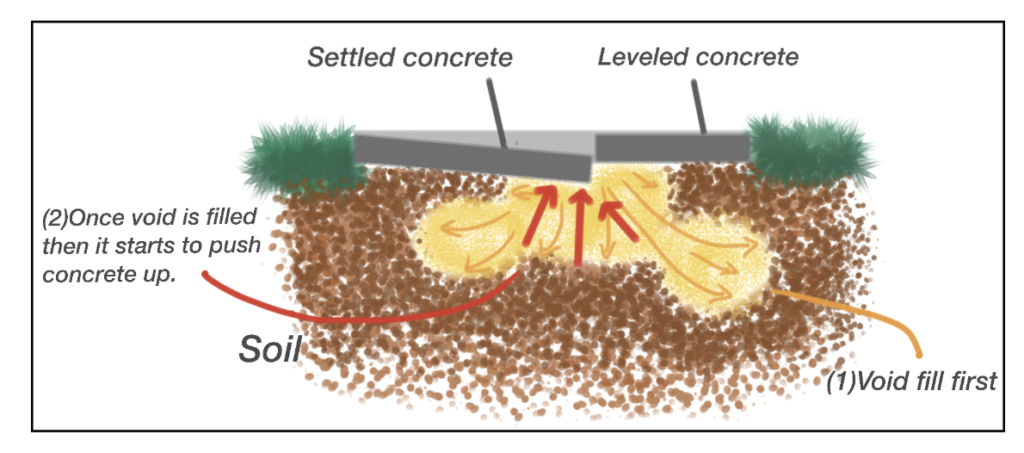
When the supporting soil shifts or washes out, the concrete above it loses support — leading to cracks, tilting, and drop.
The Science Behind Foam Lifting
At Top Level Ohio, we use engineered geotechnical polyurethane foams like those in the TerraThane series. These systems are designed specifically for lifting heavy structures and stabilizing weak soils. Here’s how the process works:
🔹 Step 1: Precision Injection
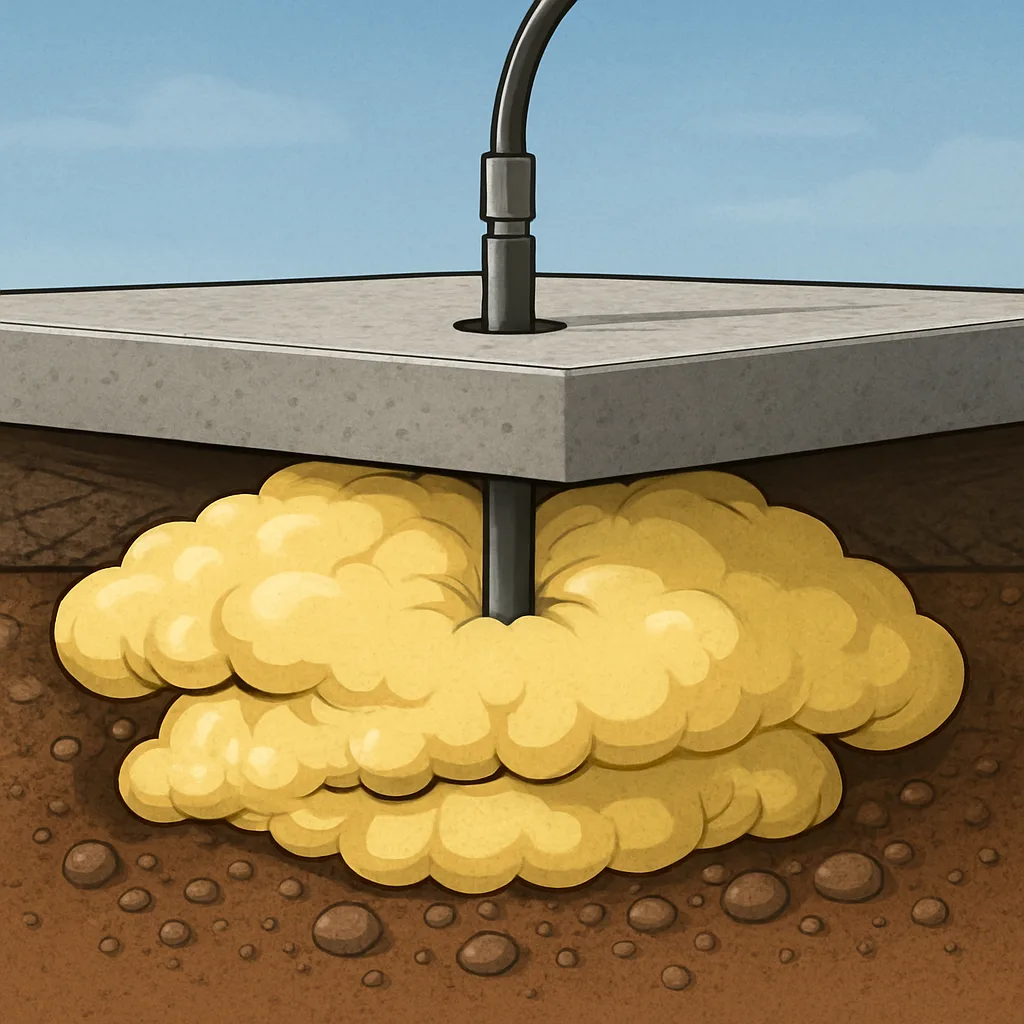
We drill small holes (about 5/8″) into the affected concrete and inject two liquid components — isocyanate and polyol. These chemicals mix and begin an immediate exothermic reaction under the slab.
🔹 Step 2: Rapid Foam Expansion
- The chemical reaction forms rigid, closed-cell polyurethane foam.
- In just seconds, this foam expands up to 30 times its original volume.
- As it expands, it flows laterally, filling voids and pore spaces in the soil — even in tight, compacted areas.
🔹 Step 3: Soil Interaction Under Pressure
The foam exerts expansion pressure up to 1,200 psi under confined conditions. This force causes:
- Densification of loose soils: The foam compacts weak zones, increasing soil bearing capacity.
- Displacement of water and air: It pushes moisture out of the soil matrix, especially useful in Ohio’s wet seasons.
- Mechanical interlock: While it doesn’t chemically bond with the soil, the foam conforms tightly to the irregularities in the ground, locking itself in place.
This stabilizes the subgrade and prevents future settling.
🔹 Step 4: Controlled Concrete Lift
Once the voids are filled and the soil compacted, the foam has nowhere to go but up — lifting the concrete slab with remarkable accuracy. The upward pressure is carefully monitored to prevent over-lifting or cracking.
- Lifting precision is often within 1/8 inch.
- The foam hardens in 15 minutes, providing structural support immediately.
🔹 Step 5: Cured, Permanent Support
After curing, the foam becomes a rigid, water-resistant, high-strength base with compressive strength between 90–240 psi, depending on the foam used. It’s stable in wet, acidic, or expansive soil environments.
Technical Advantages of Our Foam Solution
| Foam Characteristic | Performance |
|---|---|
| Expansion Pressure | Up to 1,200 psi under slab |
| Soil Interaction | Compacts, stabilizes, and fills pore spaces |
| Compressive Strength (Cured) | 90–240 psi depending on product |
| Cure Time | 15 minutes |
| Environmental Resistance | Waterproof, inert, and hydrophobic |
| Precision of Lift | Typically within 1/8 inch |
This approach doesn’t just lift your concrete — it treats the underlying problem by reinforcing the soil beneath, resulting in a long-term, structurally sound solution.
Applications Across Ohio
This technique is ideal for:
- Sunken driveways and sidewalks
- Garage floors and patios
- Uneven warehouse slabs
- Void-filling beneath foundations
- Anywhere traditional concrete repair fails due to poor soil
Why Choose Top Level Ohio?
At Top Level Ohio, we focus exclusively on polyurethane foam lifting for one reason: it works. Our team is trained in the latest foam injection technology and uses only premium-grade materials.
✅ Technical precision
✅ Minimal disruption
✅ Eco-friendly materials
✅ Permanent soil improvement
Contact Us Today
📞 Call Top Level Ohio at 614-305-1050
📍 Serving Columbus and surrounding areas