How to Tell If Your Sunken Concrete Is Still Repairable
Sunken concrete does not always mean full replacement is necessary. In many cases, a settled slab can still be lifted and stabilized when the concrete itself is still in usable condition and the main problem is loss of support beneath the surface.
At Top Level Ohio, concrete leveling is often the better option when the slab is still mostly intact and the issue is uneven settlement rather than complete structural failure. This is especially true for walkways, entry slabs, steps, patios, and driveways around the home.
What Sunken Concrete Usually Means
When concrete sinks, the slab is often reacting to conditions below it rather than failing on its own. Common causes include soil erosion, poor compaction, water intrusion, voids under the slab, and long-term settlement over time.
That matters because a slab can often still be repaired if the surface itself remains largely intact. If the concrete is still usable, leveling may restore support, improve drainage, and reduce unsafe height differences without removing the whole slab.
Signs the Concrete May Still Be Repairable
A sunken slab is often repairable when the concrete has dropped but has not completely broken apart. The most common signs include:
- One section of concrete sits lower than the next.
- The surface creates an uneven transition near a door, walkway, patio, or driveway.
- The slab has minor or moderate cracks but is still mostly in one piece.
- Water collects because the surface no longer drains correctly.
- Gaps or voids appear around the slab, showing lost support underneath.
These signs usually point to a support problem under the slab, not necessarily a slab that needs to be torn out. In many cases, that makes concrete leveling a practical repair option.
When Replacement May Be the Better Option
Not every slab should be lifted. If the concrete is badly shattered, crumbling, or damaged across multiple sections, replacement may be the better long-term choice.
Replacement may make more sense when the slab has deep or widespread cracks, severe deterioration, repeated failed repairs, or settlement so extreme that the concrete is no longer stable enough to lift reliably. Some sources also note that very heavy settlement or recurring underlying soil problems can push a project closer to replacement than leveling.
Front Entry Case Study
In this front entry example, the photos show a concrete stoop and adjoining walkway with visible settlement at the connection point near the front door. The transition between the stoop and the walkway appears uneven, which is exactly the kind of issue that can affect both safety and curb appeal at a home entry.
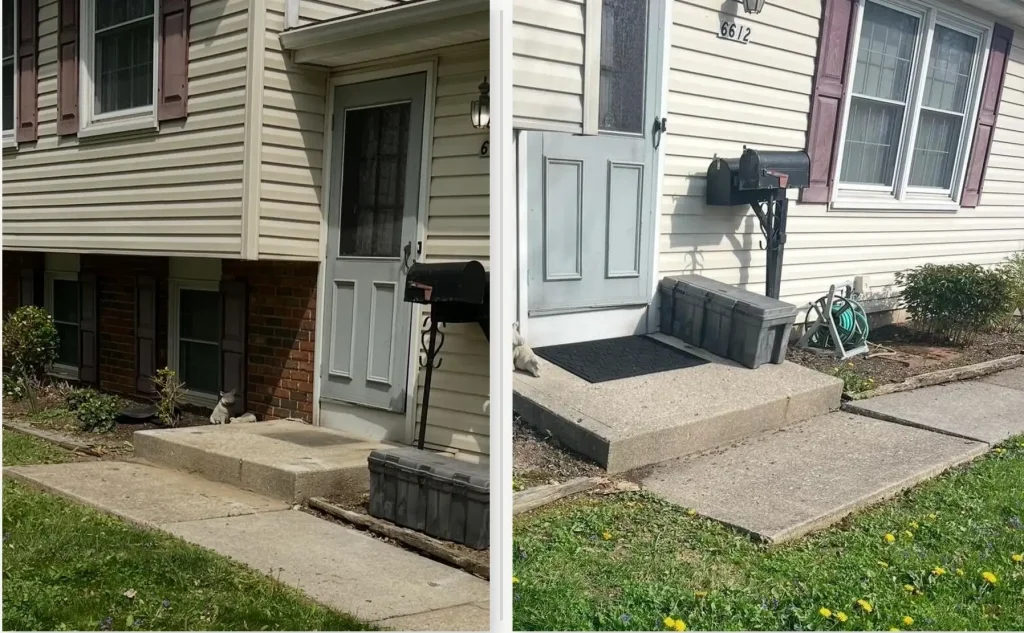
The good sign here is that the concrete appears largely intact rather than broken into multiple failed sections. Based on the photos, the visible problem looks more like settlement and misalignment than total slab failure, which is the type of condition that is often a good candidate for repair through leveling rather than full replacement.
For residential entry slabs like this, the goal is usually to restore a smoother and safer transition without the cost and disruption of removing the entire area. When the slab is still structurally usable, polyurethane foam lifting is often a strong solution because it can fill voids, improve support, and raise the settled section in a controlled way.
How Polyurethane Foam Repair Works
Top Level Ohio uses polyurethane foam injection as a repair method for settled concrete. Small holes are used to place material beneath the slab, where the expanding foam fills empty spaces, restores support, and helps raise the slab with controlled lift.
This approach is often preferred because it is faster and less disruptive than full replacement in many repairable cases. It is commonly used for sidewalks, patios, steps, porches, driveways, and other residential concrete surfaces that are still worth saving.
Frequently Asked Questions
Can sunken concrete be repaired without replacing it?
Yes, in many cases it can. If the slab is still mostly intact, leveling is often a good alternative to replacement.
Is concrete leveling better than replacement?
It depends on the slab condition. Leveling is often best for minor to moderate settlement, while replacement is better for severe breakage or major deterioration.
What causes concrete to sink near a house?
Common causes include poor soil compaction, water washout, drainage issues, and voids beneath the slab. These are some of the most frequently cited reasons concrete settles over time.
How do I know if my concrete is too damaged to lift?
If it is badly shattered, crumbling, or cracked across multiple unstable sections, replacement may be the better option. If it is still mostly in one piece, it may still be repairable.
How long does concrete leveling take?
Many leveling jobs can be completed much faster than replacement, often within a few hours depending on the slab size and condition.
Is polyurethane foam lifting worth it?
It is often worth it when the slab is still serviceable and the main issue is settlement. It avoids full demolition and is commonly used to restore support under sunken concrete.
Why is my front step or walkway sinking?
Front steps and walkways often sink because the soil beneath them shifts, erodes, or loses strength over time. Water around the home can make this problem worse.
Is uneven concrete a safety problem?
Yes. Uneven concrete can create trip hazards, especially near entryways, sidewalks, and transitions between slabs.
📞 Call Top Level Ohio: 614-305-1050
📍 Proudly serving Columbus and surrounding Central Ohio communities
💬 Free inspection, analysis, and estimate