Does Home Insurance Cover Concrete Leveling Damage in Ohio?
When concrete starts sinking around your home, one of the first questions most homeowners ask is whether insurance will help cover the damage. Another common question is whether home insurance will pay for concrete leveling in Ohio.
In many cases, the answer is more complicated than homeowners expect. Standard home insurance policies may cover certain types of sudden accidental damage, but they often exclude many of the most common causes of sunken concrete, settlement, and leveling-related repairs.
This article is general information only and is not legal or insurance advice. Always review your own policy and speak with your insurance agent for specific guidance.
How Home Insurance Usually Works
Home insurance is designed to cover sudden and accidental damage. It is not meant to act like a maintenance plan for long-term wear, aging, or gradual structural movement.
Typical policies may:
- Cover damage caused by fire, wind, hail, vandalism, or some types of sudden water damage.
- Exclude long-term deterioration, maintenance issues, neglect, and ordinary settlement.
Insurance guides that discuss foundation and structural damage explain that coverage usually depends on the cause of the damage, not simply the fact that damage exists.
Are Sunken Concrete and Settlement Covered in Ohio?
Why Settlement Is Usually Excluded
Most Ohio homeowners insurance policies treat settlement and soil movement as excluded risks. Policy language often refers to settling, shrinking, bulging, earth movement, or expansion of foundations, walls, floors, and slabs.
Insurance resources commonly note that:
- Gradual foundation cracks caused by normal settling are usually not covered.
- Damage caused by shifting soil or earth movement is generally excluded unless extra coverage has been added.
That means one of the most common causes of concrete leveling damage in Ohio—long-term soil movement beneath driveways, patios, sidewalks, or steps—is usually viewed as a maintenance issue rather than an insurance claim.
Sinkholes and Special Earth-Movement Risks
Some homeowners worry that sunken concrete might be related to a sinkhole. In Ohio, standard homeowners insurance policies generally do not automatically include sinkhole coverage.
Ohio insurance sources explain that:
- Sinkhole protection may be available through separate endorsements or stand-alone coverage.
- Even with that coverage, policies may pay for structural damage and not necessarily for every part of the ground or slab repair itself.
For most residential concrete leveling situations in Ohio, the issue is ordinary settlement, not a covered sinkhole event.
When Concrete Damage Is Usually Not Covered
In many real-world cases, insurance will not pay for concrete leveling or slab repair if the damage comes from:
- Long-term soil settlement under a driveway, patio, sidewalk, or front steps.
- Seasonal freeze-thaw movement or frost-related shifting.
- Poor base compaction or original construction problems.
- Normal aging, cracking, deterioration, or lack of maintenance.
That is because insurers generally treat these conditions as predictable long-term property issues rather than sudden losses.
When Concrete Damage Might Be Covered
There are situations where part of the concrete damage may be covered if the cause is tied directly to a covered peril.
Examples may include:
- A tree falls during a storm and damages your driveway or entry slab.
- A vehicle crashes into a concrete surface on your property.
- A burst pipe suddenly washes out soil and causes a slab to drop.
Insurance guides that discuss foundation and driveway claims emphasize two important points:
- The cause must usually be sudden and accidental.
- The insurer may pay to restore the damaged area, but not necessarily for broader leveling work or upgrades beyond the original condition.
Driveways, Sidewalks, and Patios Under Your Policy
In many policies, driveways and walkways may be treated as part of the dwelling or as other structures, depending on where they are located and how they connect to the property.
Insurance coverage discussions explain that:
- Driveways may be covered for sudden events such as falling trees, storm impact, or vehicle damage.
- They are usually not covered for long-term cracking, spalling, or gradual sinking caused by soil settlement or age.
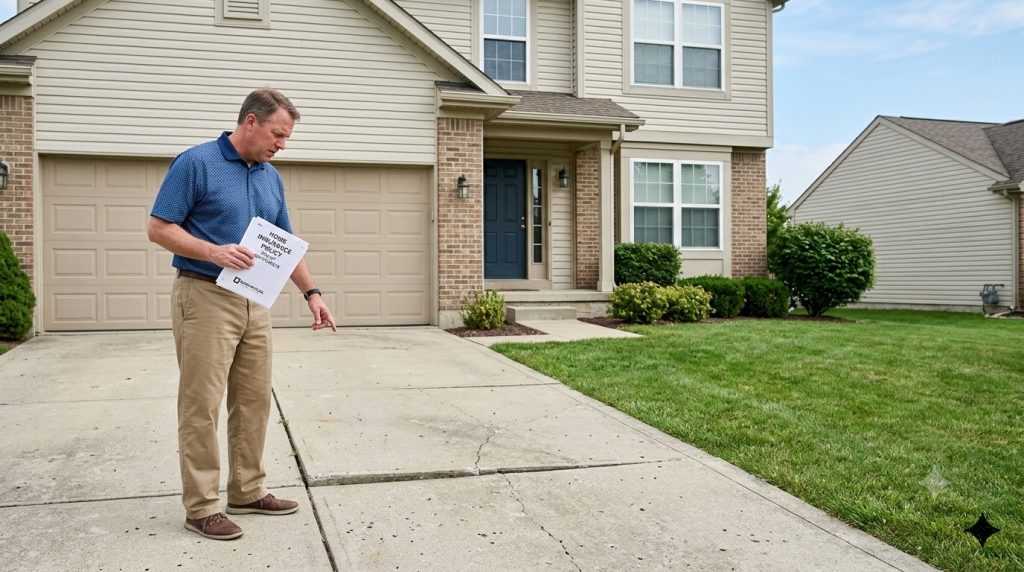
So if your Ohio driveway has slowly sunk over several years, your insurer will usually view it as a maintenance problem. If a sudden storm event causes direct damage, part of that repair may be covered.
What About Foundation Damage and Insurance?
Foundation damage follows many of the same coverage rules. Standard homeowners insurance typically covers foundation damage only when it results from a covered peril such as fire, explosion, or a sudden plumbing failure.
Common exclusions usually include:
- Soil settling and shifting.
- Faulty construction or poor materials.
- Long-term water intrusion, neglect, or gradual deterioration.
If the foundation or slab is moving because the soil beneath it is gradually changing over time, that is usually not covered under a standard policy.
Will Insurance Pay for Concrete Leveling in Ohio?
From an insurance standpoint, concrete leveling is a repair method, not a covered category of damage by itself. Insurers usually look at what caused the problem first. They do not decide based on whether the repair method is foam leveling, polyjacking, mudjacking, or replacement.
Because settlement and soil movement are usually excluded:
- Concrete leveling is often treated as an out-of-pocket repair.
- Homeowners usually pay for leveling when the problem developed gradually over time.
Even when a covered event is involved, the insurer may only pay to return the structure to its previous condition. Additional leveling improvements or preventative upgrades may still remain the homeowner’s responsibility.
How to Check Your Policy in Ohio
Step 1: Read the Exclusions
Look for terms such as:
- Settling, shrinking, bulging, or expansion.
- Earth movement, subsidence, or ground movement.
- Wear and tear, neglect, or maintenance.
These sections often explain why many concrete leveling claims are denied.
Step 2: Look for Extra Endorsements
Some Ohio insurance guides mention optional policy additions such as:
- Sinkhole coverage.
- Mine subsidence protection in certain areas.
- Expanded earth-movement or structural endorsements.
If your policy includes one of these options, your coverage may be broader than a standard policy. Still, each endorsement has its own limits and definitions.
Step 3: Ask Specific Questions
When talking with your insurance agent, ask direct questions like:
- “Is gradual driveway settlement covered?”
- “What if a burst pipe causes the slab to drop?”
- “Would a sunken sidewalk be covered if someone gets hurt?”
Insurance experts often stress that claims depend heavily on the exact cause of the damage, so specific examples help avoid vague answers.
Practical Scenarios for Ohio Homeowners
- Gradually sinking driveway with no sudden event
– Likely cause: long-term settlement.
– Likely result: usually not covered. - Tree falls and cracks the front steps during a storm
– Likely cause: covered peril.
– Likely result: damage may be covered, depending on the deductible and policy terms. - Burst pipe causes the slab to sink suddenly
– Likely cause: sudden accidental water damage.
– Likely result: part of the structural repair may be covered. - Sunken sidewalk becomes a trip hazard over time
– Likely cause: long-term settlement.
– Likely result: repair is usually not covered, even though liability concerns may still exist if someone is injured.
Frequently Asked Questions
Does home insurance cover concrete leveling damage in Ohio?
Usually not. Most policies exclude settlement, earth movement, and long-term deterioration, which are the most common causes of sunken concrete.
Will home insurance pay for concrete leveling?
In most cases, no. Concrete leveling is usually considered a repair method for a maintenance-related issue unless the damage was caused by a covered peril.
Is a sinking driveway covered by insurance?
Only in limited cases. If the damage happened because of a sudden covered event, there may be coverage. If it happened gradually, it is usually excluded.
Does insurance cover foundation settlement in Ohio?
Standard homeowners insurance generally does not cover foundation settlement caused by soil movement or gradual shifting. Coverage may apply only if a covered event directly caused the damage.
Is sinkhole coverage included in Ohio homeowners insurance?
Not usually. Sinkhole coverage is often separate and may need to be added by endorsement or purchased as separate protection.
Can I file a claim if someone trips on my uneven sidewalk?
You may be able to file a liability-related claim if someone is injured, but that does not mean the insurer will pay to fix the long-term settlement that created the hazard.
When to Call a Concrete Leveling Contractor Instead
For most residential concrete settlement problems in Ohio, homeowners end up paying for the repair themselves. That is because insurance is meant for sudden covered losses, not long-term settlement or routine structural maintenance.
In those situations, professional concrete leveling is often the practical next step. Instead of leaving the surface uneven and hoping insurance will pay later, homeowners can correct the issue early, improve safety, and reduce the chance of future damage or liability.
📞 Call Top Level Ohio: 614-305-1050
📍 Proudly serving Columbus and surrounding Central Ohio communities
💬 Free inspection, analysis, and estimate