Safety First: Fixing Uneven Front Steps and Walkways in Columbus, Ohio
A safer home entrance starts before anyone reaches the front door. The walkway, porch landing, and steps should provide a stable route for family members, visitors, and delivery workers. When concrete settles or shifts, that familiar path can become difficult to navigate.
For homeowners in Columbus, Ohio, uneven concrete steps deserve attention—not just because they affect curb appeal, but because they can create unexpected changes in height underfoot. A sunken walkway or tilted landing can also make the transition to the stairs less predictable.
At Top Level Ohio, we believe safety should guide concrete repair decisions. That means identifying the problem, understanding what caused it, and recommending a repair that fits the condition of the entrance.
Why Uneven Concrete Steps Are a Safety Concern
People often use their front entrance without studying every step. They may be carrying groceries, helping a child, or arriving after dark. An unexpected change in elevation can interrupt that routine.
Settlement can affect an entrance in several ways:
- A walkway slab drops below the first step.
- A porch landing tilts or separates from the stairs.
- A concrete step assembly settles unevenly.
- Adjacent slabs develop raised edges.
- Damaged corners reduce the usable stepping surface.
Concrete repair is only one part of entrance safety. Clear lighting, secure handrails, and suitable traction on wet surfaces also matter. The National Institute on Aging identifies these features as important home-safety measures.
Warning Signs Around Your Front Entrance
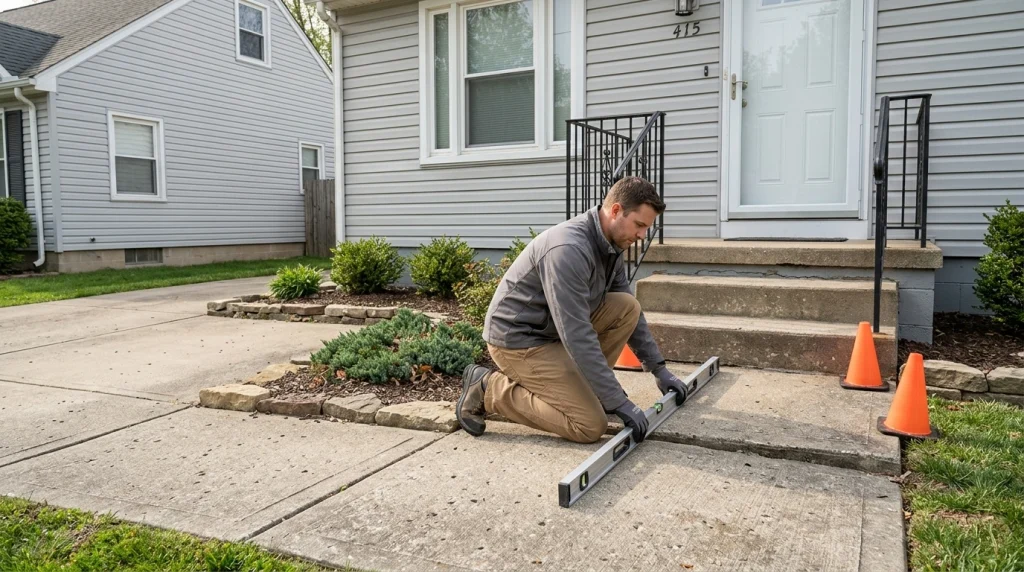
An entrance does not have to look severely damaged to deserve an inspection. Look at the entire route from the driveway or sidewalk to the front door, rather than focusing on one crack.
A Raised Edge Between Walkway Slabs
When one panel sits higher than the next, its edge can catch a shoe. Check joints near the driveway, steps, and porch, where people frequently change direction.
An Unusually High First Step
Sometimes the stairs have not moved—the walkway approaching them has sunk. This can make the first step noticeably higher than the others.
The repair should address the settled surface, not simply cover the height difference.
A Tilted or Sunken Landing
A landing should provide a stable place to pause before opening the door or using the stairs. If it slopes unexpectedly, separates from nearby concrete, or collects water, it needs closer evaluation.
Crumbling Edges or Widening Cracks
Surface wear and settlement are different problems. Broken corners, deep cracks, and deteriorated concrete may require repairs beyond lifting.
A sound slab that has settled may be suitable for leveling. Concrete that has lost too much integrity may need replacement instead.
Why Front Steps and Walkways Settle
Concrete depends on the material beneath it for support. If that support changes, the concrete above can move.
Possible causes include:
- Fill material that compresses over time.
- Soil erosion beneath the concrete.
- Water repeatedly collecting near slab edges.
- Poorly compacted ground.
- Changes in moisture beneath the entrance.
These conditions can create voids or uneven support. A contractor should evaluate the slab and its surroundings before selecting a repair method. Lifting the surface without considering ongoing water or soil problems may leave the entrance vulnerable to further movement.
For a Columbus home, the inspection should also consider how rain and snowmelt move through the entrance area. A repair plan needs to address both the elevation of the concrete and the conditions affecting its support.
Can Concrete Leveling Fix Uneven Concrete Steps?
Concrete leveling may be an option when the concrete is sufficiently intact and the main problem is settlement.
The process generally involves drilling access holes and introducing a leveling material beneath the concrete. Depending on the method, contractors may use polyurethane foam or a cement-based mixture to fill voids and raise settled sections. The access holes are patched after the lift.
Potential candidates include:
- A sunken walkway approaching the stairs.
- A settled porch landing.
- An intact concrete step assembly that has dropped.
- A low slab creating an uneven transition at the entrance.
However, lifting a walkway panel is not the same as lifting a stair assembly. Steps attached to the home, masonry stairs, and structures that carry additional loads require careful assessment.
The goal is not to make every surface perfectly horizontal. Exterior concrete may need an appropriate slope for drainage, while steps need consistent, usable geometry. The contractor should evaluate both before proceeding.
When Replacement or Another Repair Is More Appropriate
Not every entrance problem can be solved with concrete leveling.
Replacement or a different repair approach may be necessary when:
- Concrete is severely fractured or crumbling.
- Steps have damaged treads or extensive deterioration.
- The original stair dimensions are unsuitable.
- Movement appears connected to the building or foundation.
- A handrail or another attached component is unstable.
- Lifting would create a problem at the doorway or adjoining surface.
Leveling repositions existing concrete; it does not rebuild damaged treads or redesign a staircase. Extensive deterioration and problems connected to the foundation or widespread soil movement can require specialist evaluation.
An honest recommendation should explain what the proposed repair can accomplish—and what it cannot.
Drainage Matters as Much as Elevation
A safer entrance should not repeatedly collect water at the bottom of the steps or beside the landing.
During an inspection, pay attention to:
- Downspouts releasing water beside the walkway.
- Low spots that remain wet after rain.
- Water flowing toward the doorway.
- Soil washing away along concrete edges.
- Changes in drainage after a slab settles.
Concrete leveling may improve drainage when settlement has changed the slope. However, it cannot replace necessary gutter repairs, grading improvements, or other water-management work.
Addressing active water problems alongside the concrete repair helps protect the supporting ground and the repaired surface.
Lighting, Handrails, and a Clear Walking Route
Fixing uneven concrete steps should be part of a broader entrance-safety plan.
Improve Visibility
Make sure the approach, stair edges, and landing are visible after dark. Lighting should help people see changes in elevation without creating distracting glare or deep shadows.
Check Handrails
Look for loose fittings, movement, or damaged sections. A repaired concrete surface does not compensate for an unreliable handrail.
Keep the Route Clear
Remove hoses, loose objects, and decorations that narrow the walking path. Pay attention to mats that curl, shift, or hide damaged concrete.
Fall-prevention guidance recommends secure handrails, adequate stair lighting, and well-lit outdoor entrances. These measures complement concrete repair rather than replace it.
A Front Entrance Safety Checklist
Use this checklist to identify concerns before requesting an assessment:
- Are adjacent walkway slabs at noticeably different heights?
- Does the first step feel higher or lower than the remaining steps?
- Is the landing tilted, cracked, or separating?
- Are concrete edges broken or crumbling?
- Does water collect along the walking route?
- Are the steps and landing clearly visible at night?
- Do the handrails feel secure?
- Are mats and other objects creating obstacles?
- Has the condition changed since the last inspection?
If you find a significant hazard, discourage use of the affected route where practical and arrange an assessment. Avoid hiding the problem beneath a mat or improvising a ramp from loose materials.
What to Expect From a Professional Assessment
A useful assessment should go beyond pointing out the low slab.
The contractor should examine:
- The condition of the concrete.
- The relationship between the walkway, steps, landing, and doorway.
- Signs of lost support beneath the surface.
- Drainage patterns and nearby water sources.
- Connections to the home or other structures.
- Whether lifting, localized repair, replacement, or specialist evaluation is appropriate.
Ask how the proposed work will affect the entrance as a whole. A successful repair should improve the transition between surfaces without creating a new height difference elsewhere.
Frequently Asked Questions
Can uneven concrete steps be repaired without replacement?
Sometimes. Intact steps or nearby slabs that have settled may be candidates for leveling. Damaged treads, extensive deterioration, or unsuitable stair geometry may require another approach.
Can leveling the walkway improve the first step?
If the walkway has sunk and made the first step unusually high, raising the walkway may improve the transition. The final elevation must account for the remaining steps, nearby surfaces, and drainage.
Does every crack mean the concrete needs replacement?
No. Crack severity, movement, and the overall condition of the concrete matter. A crack alone does not establish whether leveling or replacement is appropriate.
Will leveling prevent all future settlement?
No repair can guarantee that surrounding soil will never move. Managing drainage and addressing the cause of settlement remain important.
Should I wait until the entrance becomes difficult to use?
It is better to assess a developing problem before it becomes a more serious obstacle. An inspection can help distinguish a repairable settled surface from deteriorated concrete or a structural concern.
Put Safety First at Your Front Door
Your front entrance should welcome people—not make them navigate unexpected edges or unstable surfaces.
At Top Level Ohio, our safety-first approach starts with understanding the problem. We believe in practical recommendations, clear explanations, and repair decisions that put people before unnecessary work.
If you have uneven concrete steps, a sunken walkway, or a tilted porch landing in Columbus, contact Top Level Ohio to discuss an assessment and the options for improving your entrance.
📞 Call Top Level Ohio: 614-305-1050
📍 Serving Columbus and surrounding Central Ohio communities
💬 Free consultation, analysis, and estimate