Safety First: A Concrete Walkway Safety Checklist for Columbus Businesses
A customer’s experience begins before they reach your front door. The route from the parking lot to the entrance should be clear, stable, and easy to navigate. When concrete settles, edges break, or water collects along that route, an ordinary walkway can become a safety concern.
For business owners and property managers in Columbus, Ohio, concrete walkway safety should be part of routine property maintenance—not something considered only after an incident.
A practical inspection process can help you identify developing problems, protect affected areas, and arrange appropriate repairs. At Top Level Ohio, we believe a safety-first approach begins with understanding the condition of the concrete and recommending work that addresses the actual problem.
Start With the Entire Walking Route
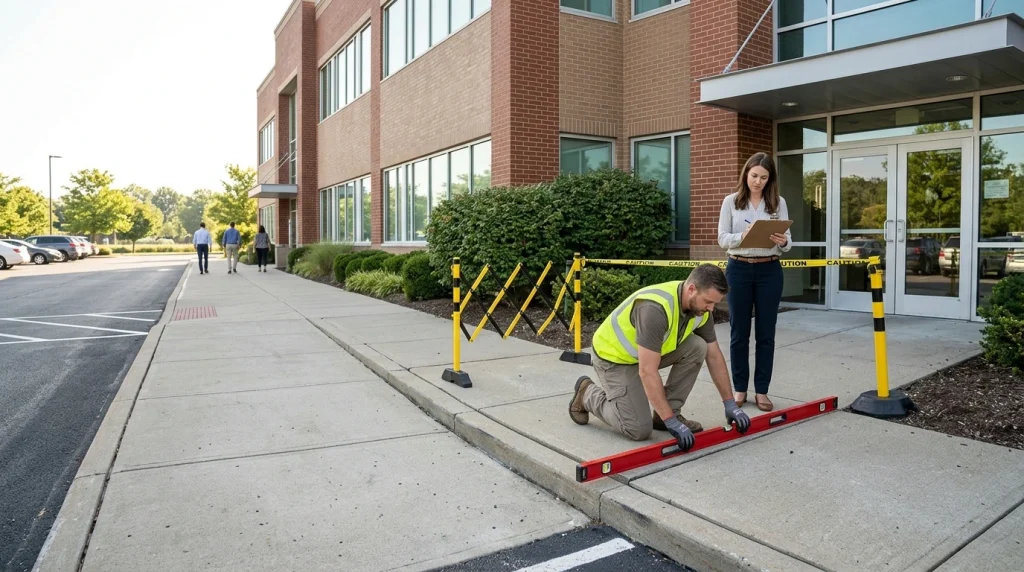
Walkway inspections should cover more than the slab directly outside the entrance. Follow the same route employees, customers, and delivery workers use to reach the building.
Include:
- Walkways connecting parking spaces to the entrance.
- Sidewalks along the property.
- Concrete landings outside doors.
- Transitions between ramps, steps, and adjoining slabs.
- Routes to secondary entrances.
- Areas near downspouts, landscaping, and drainage outlets.
Look at how these surfaces connect. A walkway panel may appear sound on its own but still create an abrupt height change where it meets another slab.
Avoid treating the inspection as a quick visual check from the doorway. Walking the full route makes it easier to notice problems that are less visible from a distance.
A Concrete Walkway Safety Checklist
Use the following checklist to organize inspections and determine which areas need closer attention.
1. Check for Uneven Slabs and Raised Edges
Look for joints where one concrete panel sits higher or lower than the next.
Common warning signs include:
- A raised edge across the walking path.
- A slab that has dropped near the entrance.
- A tilted panel connecting to a landing.
- An uneven transition between the walkway and a ramp.
- A noticeable change in elevation near a step.
Document the location and extent of the difference. Do not assume that an uneven surface is harmless simply because regular occupants have learned to step around it.
2. Inspect Cracks, Corners, and Surface Deterioration
Not all cracks indicate the same problem. A narrow surface crack differs from a fractured slab with loose pieces or crumbling edges.
Pay attention to:
- Broken corners along the pedestrian route.
- Loose concrete fragments.
- Widening cracks.
- Deep surface deterioration.
- Missing sections that interrupt the walking surface.
A mostly intact slab affected by settlement may be suitable for leveling. Severely broken or deteriorated concrete may require replacement instead.
3. Look for Standing Water and Drainage Problems
Check whether water drains away from the walking route or collects in low spots.
Inspect areas:
- Beneath downspouts.
- Beside building entrances.
- At the bottom of ramps.
- Along settled walkway panels.
- Near landscaping that directs runoff onto concrete.
A drainage problem may involve the slab’s elevation, nearby grading, or the water source itself. Raising settled concrete can sometimes improve the slope, but leveling alone cannot correct every drainage issue. Some situations require grading changes or replacement to establish an appropriate drainage pattern.
4. Check for Snow, Ice, Debris, and Other Obstacles
Concrete walkway safety includes temporary conditions as well as permanent damage.
Look for:
- Snow or ice covering joints and edges.
- Leaves or debris concealing uneven surfaces.
- Hoses, cords, or equipment across the route.
- Loose or curled entrance mats.
- Signs, displays, or stored materials narrowing the path.
Assign responsibility for removing obstacles and monitoring changing conditions. A repaired walkway still needs routine attention to remain usable.
5. Review Entrances, Ramps, and Landings
Check the points where pedestrians change direction, open a door, or move between different surfaces.
Ask:
- Does the door open without catching on the concrete?
- Is the landing stable and unobstructed?
- Has settlement created a difficult transition at the ramp?
- Is there sufficient room to use the entrance?
- Are handrails secure where provided?
These questions help identify concerns, but a visual checklist is not an accessibility assessment. Where accessibility requirements apply, have the route evaluated against the relevant standards.
6. Assess Visibility
Inspect the walkway after dark as well as during daylight.
Consider whether lighting makes slab edges, steps, and changes in elevation visible. Look for failed fixtures, deep shadows, or landscaping that blocks light.
Better lighting can help people see the route, but it should not be used as a substitute for repairing damaged or uneven concrete.
What to Do When You Find a Hazard
Finding a problem is only the first step. The inspection process should also establish who will respond and how the affected area will be managed.
For workplaces covered by OSHA’s general-industry walking-working surface requirements, hazardous conditions must be corrected or repaired before employees use the affected surface again. If immediate correction is not possible, the hazard must be guarded to prevent employee use until it is repaired.
Restrict Access Where Necessary
Use an appropriate barrier or other effective measure to prevent access to the affected area. A warning sign may alert people, but it does not necessarily keep them from walking across a hazardous surface.
Provide an Alternative Route
Where practical, direct pedestrians along a clear route that avoids the problem. Make sure the alternative does not introduce another obstacle or send people into vehicle traffic.
If the closure affects an accessible entrance or route, obtain appropriate guidance before establishing the temporary arrangement.
Arrange the Right Assessment
Contact a concrete repair professional when the issue involves settlement, damaged slabs, or suspected loss of support.
Where structural integrity is involved, OSHA requires the correction or repair to be performed or supervised by a qualified person in workplaces covered by that provision.
Temporary precautions should remain in place until the affected route is ready to reopen—not simply until a repair appointment has been scheduled.
When Concrete Leveling May Be Appropriate
Concrete leveling can be a practical option when a walkway slab has settled but remains in repairable condition.
A professional assessment may identify:
- Voids beneath an otherwise intact slab.
- Settlement creating uneven joints.
- A low panel interrupting the route to the entrance.
- A drainage problem caused by a change in slab elevation.
The leveling process generally involves drilling small access holes and injecting material beneath the concrete to fill voids and lift settled sections. After the lift, the access points are sealed and the repaired surface is reviewed.
For businesses considering commercial concrete leveling in Columbus, Ohio, the important question is not simply whether a slab can be raised. It is whether lifting will improve the route without creating problems at adjoining panels, ramps, doors, or landings.
The assessment should also consider the cause of settlement and any water-management work needed alongside the repair.
When Replacement or Another Repair Is Needed
Concrete leveling is not suitable for every walkway.
Replacement may be more appropriate when:
- Slabs are severely broken.
- Large sections are crumbling or missing.
- The surface is extensively deteriorated.
- The concrete cannot be lifted safely.
- Major structural damage is present.
A contractor may also recommend localized repair or another treatment rather than lifting the entire slab. The recommendation should follow an assessment of the concrete’s condition, the nature of the hazard, and the intended use of the route.
Avoid choosing a repair solely on its initial price. The better solution is the one that addresses the problem without leaving a compromised walking surface in place.
Reinspect Before Reopening the Walkway
Completion of the repair should be followed by a final review.
Before restoring access, check:
- Transitions between repaired and adjoining surfaces.
- The route to doors, steps, ramps, and landings.
- Remaining broken edges or loose material.
- Tools, debris, and temporary equipment.
- Any restrictions on when the surface can be used.
Follow the contractor’s return-to-use instructions. Different repair methods and materials may require different waiting periods.
Drainage should also be checked when conditions allow. A dry-weather inspection cannot show every issue that becomes apparent during rain.
Keep a Simple Maintenance Record
A consistent record helps property managers track changing conditions and follow up on outstanding work.
For each inspection, record:
| Item | What to Record |
|---|---|
| Inspection date | When the route was checked |
| Location | The specific slab, entrance, or walkway section |
| Observed condition | Settlement, damage, water, ice, or obstruction |
| Photographs | Clear images showing the condition and location |
| Immediate action | Access restriction, cleanup, or temporary routing |
| Assigned responsibility | Who will arrange and follow up on the work |
| Repair status | Scheduled, completed, or awaiting assessment |
| Follow-up | Findings after repair or later weather events |
Documentation supports maintenance planning. It does not replace hazard correction or establish legal compliance by itself.
How Often Should Businesses Inspect Walkways?
The inspection schedule should reflect the property’s conditions, pedestrian use, and maintenance needs.
OSHA’s relevant standard calls for inspections “regularly and as necessary”; it does not establish one universal inspection interval for every workplace. Additional checks may be needed when circumstances change
For a Columbus property, useful occasions for an additional walkthrough include:
- After snow and ice have cleared.
- Following heavy rain or visible erosion.
- After utility work or nearby excavation.
- When someone reports a problem.
- After a repair.
- When a previously documented condition appears to have changed.
Assign a responsible person and make sure reported concerns reach someone who can act on them.
Frequently Asked Questions
Can a settled commercial walkway be repaired without replacement?
Often, yes. If the concrete is sufficiently intact and settlement is the main issue, leveling may be an option. Extensive deterioration or structural damage can make replacement more appropriate.
Is a warning sign enough until the repair is completed?
Not necessarily. In workplaces covered by OSHA’s relevant requirement, a hazard that cannot be corrected immediately must be guarded to prevent employee use of the affected surface. A sign alone may not accomplish that.ecfr
Can concrete leveling fix standing water?
It may help when settlement has changed the walkway’s slope. However, drainage problems caused by grading, runoff sources, or the original design may require additional work.
Should damaged concrete be repaired before leveling?
The sequence depends on the condition of the slab and the proposed method. Have the contractor explain how cracking, deterioration, and settlement will be addressed together.
Does this checklist guarantee OSHA or accessibility compliance?
No. This article provides general maintenance guidance. Applicable workplace, accessibility, and building requirements need to be evaluated for the specific property.
Put Safety First on Every Route to Your Business
Concrete walkway safety begins with consistent attention: inspect the route, respond to concerns, select an appropriate repair, and verify the result.
At Top Level Ohio, we believe a responsible recommendation should address the condition of the concrete—not simply sell the largest project. If your Columbus property has sunken walkway panels, uneven transitions, or damaged concrete near an entrance, contact our team to discuss an assessment.
A clearer understanding of the problem is the first step toward a safer, better-maintained property.
📞 Call Top Level Ohio: 614-305-1050
📍 Serving Columbus and surrounding Central Ohio communities
💬 Free consultation, analysis, and estimate