Fix Sinking Concrete in Columbus: The Hidden Role of Soil and Water Beneath Your Slabs
In Central Ohio, many homeowners try to fix sinking concrete in Columbus by improving drainage around their property—adding yard drains, extending downspouts, installing new slope lines, or reworking low areas after heavy rain problems.
Better drainage absolutely matters.
But in Columbus and surrounding communities, concrete settlement is not just a surface-water problem.
The real key to long-term results is understanding how water movement and local soil conditions interact beneath your slab.
If you are looking for the right way to fix sinking concrete in Columbus, this hidden relationship between soil and moisture is what determines whether your repair lasts—or keeps coming back.
Why Columbus homeowners often start with drainage when trying to fix sinking concrete
When a driveway, sidewalk, patio, or garage slab begins to drop, the most common assumptions are:
- water is collecting near the slab
- the yard is not sloped correctly
- downspouts are discharging too close to the concrete
As a result, many homeowners attempt to fix sinking concrete by:
- installing yard drains or catch basins
- extending downspouts
- adding underground drain lines
- regrading soil around slabs
- improving runoff toward the street
These improvements can help surface drainage.
However, they also change how moisture moves underground—and that is where concrete performance is decided.
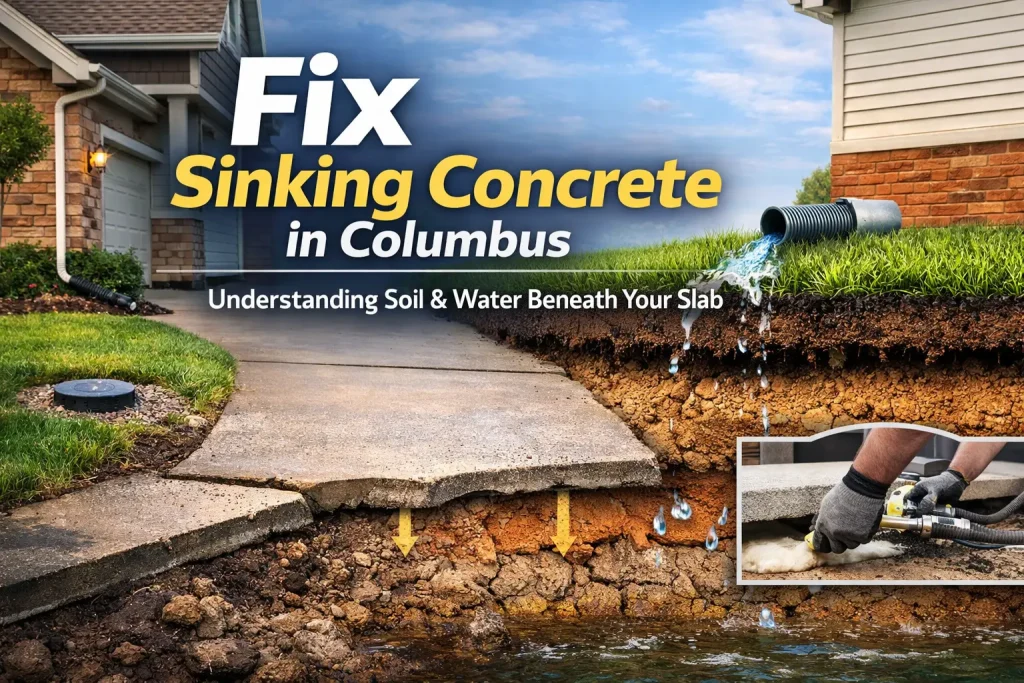
The real reason concrete moves: what happens beneath the slab
In the Columbus area, subsurface soils are typically made up of:
- silty clay
- clay-loam blends
- compacted fill around newer construction
These soils behave very differently than sandy soils found in other parts of the country.
When homeowners try to fix sinking concrete in Columbus using drainage alone, the soil beneath the slab can experience:
- changes in moisture balance
- softening of load-bearing layers
- consolidation of clay zones
- repeated wet–dry cycles that reduce soil strength
Concrete does not fail simply because water touches it.
It moves because the soil beneath it changes volume and load-carrying capacity.
How soil and drainage together influence concrete settlement in Columbus
1. Clay soil consolidation after moisture patterns change
Columbus-area clay soils are highly sensitive to moisture variation.
When new drainage systems redirect water away from some areas and concentrate it in others, the supporting soil can begin to:
- shrink
- consolidate
- lose uniform bearing support
This is one of the most common reasons homeowners end up searching again for how to fix sinking concrete after recently upgrading their drainage.
2. Drainage trenches create different support conditions next to slabs
Most drainage projects require trenching near:
- driveways
- sidewalks
- patios
- garage slabs
Even when trenches are properly backfilled, the soil inside those trenches behaves differently than undisturbed ground. Over time, these areas may:
- settle more than surrounding soil
- absorb water more easily
- lose density under repeated loading
Concrete naturally moves toward the weaker support zone—creating new low areas even when the slab was previously stable.
3. Concentrated roof runoff near slab edges
Extending downspouts is one of the most popular ways homeowners attempt to fix sinking concrete in Columbus.
However, when large volumes of roof runoff are discharged into a small area, the soil beneath nearby slabs can become:
- repeatedly saturated
- softened under load
- more prone to long-term consolidation
This often leads to settlement along driveway edges, sidewalk panels, and garage approaches.
4. Regrading that improves surface flow but alters subsurface moisture
Regrading frequently improves how water moves across the yard.
But in many Central Ohio properties, it can unintentionally create shallow subsurface moisture zones near:
- garage entries
- side-yard walkways
- patio edges
In these situations, concrete can begin to settle even though surface water is no longer visible.
Common Columbus scenarios where concrete movement follows drainage projects
Top Level Ohio frequently evaluates slab settlement that appears after:
- yard drainage installations around older homes
- downspout extensions near driveway corners
- landscaping projects that raise soil against slabs
- French drains installed beside patios or sidewalks
- basement waterproofing drainage systems placed close to exterior slabs
In each case, the homeowner’s goal was to fix sinking concrete, but the project changed how the soil beneath the slab carries load.
Why Central Ohio soil makes concrete more sensitive to moisture changes
Concrete movement is more common in this region because:
- clay soils expand and contract with moisture
- repeated wet–dry cycles weaken soil structure
- compacted fill around newer developments continues to settle
- winter freeze–thaw cycles accelerate movement
This is why attempting to fix sinking concrete in Columbus without addressing soil behavior rarely produces permanent results.
Warning signs your soil support is changing beneath the slab
You may notice:
- settlement developing near drain lines or discharge areas
- new cracking near slab edges
- driveway panels becoming uneven after rainfall cycles
- separation between slabs and foundations
- trip hazards forming along sidewalks
These signs usually indicate that subsurface support—not surface water alone—is driving the problem.
Why cosmetic repairs do not truly fix sinking concrete
Grinding, patching, or replacing small slab sections only improves appearance.
If soil consolidation or moisture changes are affecting the supporting layers, the slab will continue to move.
This is why many homeowners repeatedly search for how to fix sinking concrete in Columbus after surface repairs fail.
How professionals identify soil- and drainage-related settlement
To properly fix sinking concrete, experienced specialists evaluate:
- where roof and surface water is discharged
- how drainage systems intersect slab edges
- trench locations and soil disturbance zones
- nearby foundation and basement drainage systems
- long-term movement patterns around the property
The goal is not only finding water—but understanding how soil support has changed beneath the slab.
Fix sinking concrete in Columbus the right way
When moisture and soil behavior are part of the settlement pattern, long-term success depends on restoring uniform support below the slab.
For Top Level Ohio projects, this typically involves precision polyurethane leveling and stabilization to:
- lift settled concrete
- strengthen weakened soil zones
- restore consistent load distribution
- reduce future movement
This method allows homeowners to fix sinking concrete without removing and replacing large sections of slab.
Concrete settlement near foundations and basement drainage systems
In Columbus, many drainage upgrades are connected to basement waterproofing and foundation protection.
While these systems are essential, they can influence nearby slabs such as:
- front walkways
- garage floors
- basement entry slabs
- side-yard paths
Any plan to fix sinking concrete in Columbus near a foundation must account for how drainage systems interact with surrounding soil.
How to prevent new concrete problems after drainage improvements
If you are planning drainage work, it helps to:
- avoid concentrating discharge near slab edges
- place outlet points away from driveways and sidewalks
- monitor areas next to new trenches
- watch for movement after heavy rainfall
- consult a concrete leveling specialist if settlement begins
These steps significantly reduce the chance of needing repeated attempts to fix sinking concrete later.
Why early concrete leveling saves Columbus homeowners money
When settlement is addressed early:
- fewer slabs are affected
- lifting and stabilization remain localized
- surrounding landscaping and hardscape are preserved
- long-term performance is improved
Delaying repairs until large cracks, separation, and major elevation differences appear makes it harder and more expensive to fix sinking concrete permanently.
Final thoughts
Drainage improvements are important for protecting homes in Central Ohio.
But the long-term performance of your driveway, sidewalk, patio, or garage slab depends on what happens below the surface.
If you want to truly fix sinking concrete in Columbus, the solution must focus on restoring and stabilizing the soil beneath the slab—not only redirecting surface water.
Understanding the relationship between soil behavior and moisture movement is the foundation of durable results.
Schedule your free inspection with Top Level Ohio
If your concrete started settling after drainage work—or you are seeing new uneven slabs around your home—Top Level Ohio can evaluate the underlying cause and recommend the best solution to fix sinking concrete safely and effectively.
📞 Call Top Level Ohio: 614-305-1050
📍 Proudly serving Columbus and surrounding Central Ohio communities
💬 Free inspection, analysis, and estimate
Fix Sinking Concrete in Columbus: The Hidden Role of Soil and Water Beneath Your Slabs
In Central Ohio, many homeowners try to fix sinking concrete in Columbus by improving drainage around their property—adding yard drains, extending downspouts, installing new slope lines, or reworking low areas after heavy rain problems.
Better drainage absolutely matters.
But in Columbus and surrounding communities, concrete settlement is not just a surface-water problem.
The real key to long-term results is understanding how water movement and local soil conditions interact beneath your slab.
If you are looking for the right way to fix sinking concrete in Columbus, this hidden relationship between soil and moisture is what determines whether your repair lasts—or keeps coming back.
Why Columbus homeowners often start with drainage when trying to fix sinking concrete
When a driveway, sidewalk, patio, or garage slab begins to drop, the most common assumptions are:
- water is collecting near the slab
- the yard is not sloped correctly
- downspouts are discharging too close to the concrete
As a result, many homeowners attempt to fix sinking concrete by:
- installing yard drains or catch basins
- extending downspouts
- adding underground drain lines
- regrading soil around slabs
- improving runoff toward the street
These improvements can help surface drainage.
However, they also change how moisture moves underground—and that is where concrete performance is decided.
The real reason concrete moves: what happens beneath the slab
In the Columbus area, subsurface soils are typically made up of:
- silty clay
- clay-loam blends
- compacted fill around newer construction
These soils behave very differently than sandy soils found in other parts of the country.
When homeowners try to fix sinking concrete in Columbus using drainage alone, the soil beneath the slab can experience:
- changes in moisture balance
- softening of load-bearing layers
- consolidation of clay zones
- repeated wet–dry cycles that reduce soil strength
Concrete does not fail simply because water touches it.
It moves because the soil beneath it changes volume and load-carrying capacity.
How soil and drainage together influence concrete settlement in Columbus
1. Clay soil consolidation after moisture patterns change
Columbus-area clay soils are highly sensitive to moisture variation.
When new drainage systems redirect water away from some areas and concentrate it in others, the supporting soil can begin to:
- shrink
- consolidate
- lose uniform bearing support
This is one of the most common reasons homeowners end up searching again for how to fix sinking concrete after recently upgrading their drainage.
2. Drainage trenches create different support conditions next to slabs
Most drainage projects require trenching near:
- driveways
- sidewalks
- patios
- garage slabs
Even when trenches are properly backfilled, the soil inside those trenches behaves differently than undisturbed ground. Over time, these areas may:
- settle more than surrounding soil
- absorb water more easily
- lose density under repeated loading
Concrete naturally moves toward the weaker support zone—creating new low areas even when the slab was previously stable.
3. Concentrated roof runoff near slab edges
Extending downspouts is one of the most popular ways homeowners attempt to fix sinking concrete in Columbus.
However, when large volumes of roof runoff are discharged into a small area, the soil beneath nearby slabs can become:
- repeatedly saturated
- softened under load
- more prone to long-term consolidation
This often leads to settlement along driveway edges, sidewalk panels, and garage approaches.
4. Regrading that improves surface flow but alters subsurface moisture
Regrading frequently improves how water moves across the yard.
But in many Central Ohio properties, it can unintentionally create shallow subsurface moisture zones near:
- garage entries
- side-yard walkways
- patio edges
In these situations, concrete can begin to settle even though surface water is no longer visible.
Common Columbus scenarios where concrete movement follows drainage projects
Top Level Ohio frequently evaluates slab settlement that appears after:
- yard drainage installations around older homes
- downspout extensions near driveway corners
- landscaping projects that raise soil against slabs
- French drains installed beside patios or sidewalks
- basement waterproofing drainage systems placed close to exterior slabs
In each case, the homeowner’s goal was to fix sinking concrete, but the project changed how the soil beneath the slab carries load.
Why Central Ohio soil makes concrete more sensitive to moisture changes
Concrete movement is more common in this region because:
- clay soils expand and contract with moisture
- repeated wet–dry cycles weaken soil structure
- compacted fill around newer developments continues to settle
- winter freeze–thaw cycles accelerate movement
This is why attempting to fix sinking concrete in Columbus without addressing soil behavior rarely produces permanent results.
Warning signs your soil support is changing beneath the slab
You may notice:
- settlement developing near drain lines or discharge areas
- new cracking near slab edges
- driveway panels becoming uneven after rainfall cycles
- separation between slabs and foundations
- trip hazards forming along sidewalks
These signs usually indicate that subsurface support—not surface water alone—is driving the problem.
Why cosmetic repairs do not truly fix sinking concrete
Grinding, patching, or replacing small slab sections only improves appearance.
If soil consolidation or moisture changes are affecting the supporting layers, the slab will continue to move.
This is why many homeowners repeatedly search for how to fix sinking concrete in Columbus after surface repairs fail.
How professionals identify soil- and drainage-related settlement
To properly fix sinking concrete, experienced specialists evaluate:
- where roof and surface water is discharged
- how drainage systems intersect slab edges
- trench locations and soil disturbance zones
- nearby foundation and basement drainage systems
- long-term movement patterns around the property
The goal is not only finding water—but understanding how soil support has changed beneath the slab.
Fix sinking concrete in Columbus the right way
When moisture and soil behavior are part of the settlement pattern, long-term success depends on restoring uniform support below the slab.
For Top Level Ohio projects, this typically involves precision polyurethane leveling and stabilization to:
- lift settled concrete
- strengthen weakened soil zones
- restore consistent load distribution
- reduce future movement
This method allows homeowners to fix sinking concrete without removing and replacing large sections of slab.
Concrete settlement near foundations and basement drainage systems
In Columbus, many drainage upgrades are connected to basement waterproofing and foundation protection.
While these systems are essential, they can influence nearby slabs such as:
- front walkways
- garage floors
- basement entry slabs
- side-yard paths
Any plan to fix sinking concrete in Columbus near a foundation must account for how drainage systems interact with surrounding soil.
How to prevent new concrete problems after drainage improvements
If you are planning drainage work, it helps to:
- avoid concentrating discharge near slab edges
- place outlet points away from driveways and sidewalks
- monitor areas next to new trenches
- watch for movement after heavy rainfall
- consult a concrete leveling specialist if settlement begins
These steps significantly reduce the chance of needing repeated attempts to fix sinking concrete later.
Why early concrete leveling saves Columbus homeowners money
When settlement is addressed early:
- fewer slabs are affected
- lifting and stabilization remain localized
- surrounding landscaping and hardscape are preserved
- long-term performance is improved
Delaying repairs until large cracks, separation, and major elevation differences appear makes it harder and more expensive to fix sinking concrete permanently.
Final thoughts
Drainage improvements are important for protecting homes in Central Ohio.
But the long-term performance of your driveway, sidewalk, patio, or garage slab depends on what happens below the surface.
If you want to truly fix sinking concrete in Columbus, the solution must focus on restoring and stabilizing the soil beneath the slab—not only redirecting surface water.
Understanding the relationship between soil behavior and moisture movement is the foundation of durable results.
Schedule your free inspection with Top Level Ohio
If your concrete started settling after drainage work—or you are seeing new uneven slabs around your home—Top Level Ohio can evaluate the underlying cause and recommend the best solution to fix sinking concrete safely and effectively.
📞 Call Top Level Ohio: 614-305-1050
📍 Proudly serving Columbus and surrounding Central Ohio communities
💬 Free inspection, analysis, and estimate